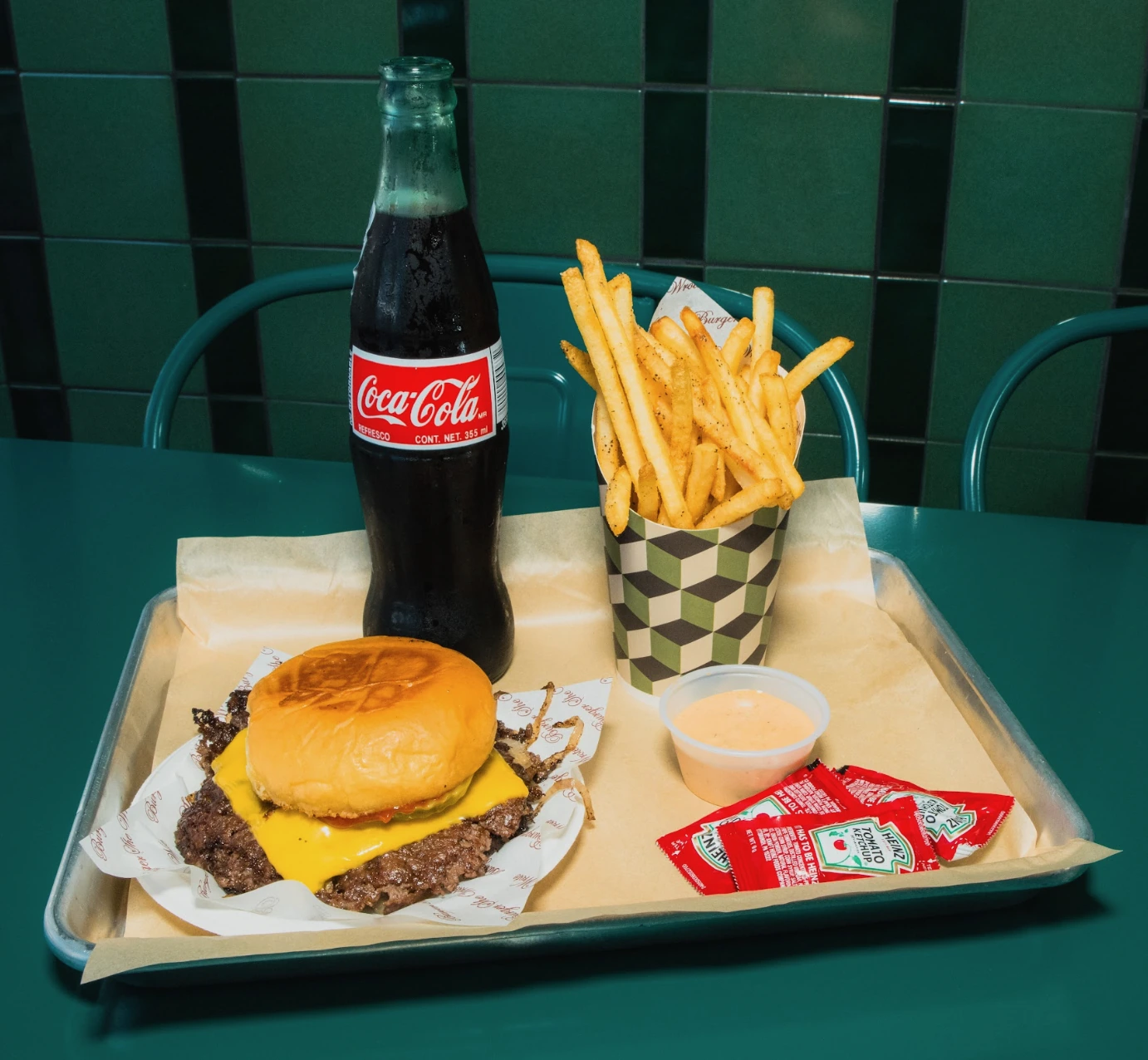
A ball of ground beef, pressed hard onto a screaming-hot griddle so it sears into a thin patty with a deeply browned crust and crispy, lacy edges, while the inside stays juicy. That contrast is the whole point.
Burger She Wrote’s Oklahoma Wagyu Smash Burger
90-180 sec
total cook time
1 smash
early, then never again
70-80% lean
the high-fat grind recipes recommend
Scroll for the science, the history, the home technique, and city guides for Southern California, New York, London and Sydney.
01 Why the smash works
It is not a trend trick. It is physics and chemistry on a flat-top.
Maximum Maillard
Pressing the beef flat puts more of its surface in direct contact with the hot metal. That supercharges the Maillard reaction, the browning that builds intense, savory flavor on the crust of the patty.
Crispy edges, juicy middle
A great smash burger has range in every bite: a plumper, meaty center and thin, frilly edges that turn crunchy. A uniformly paper-thin patty that tastes of nothing is a fail, not a feature.
Fast enough to stay juicy
Smashed patties cook in 90 to 180 seconds. That is too fast for the fat to render out or the moisture to be driven off, so the burger stays juicy by design.
Smash once, smash early
Press in the first moments of cooking, before the fat melts. Smash again after the flip and you squeeze out liquid fat, the flavor, and kill the burger.
Anatomy of a classic
Toasted bunsoft, squishy, buttered, the US standard
Sauceusually a tangy, mayo-based house sauce
American cheesemelted onto the patty on the griddle
Double stackthin patties are usually served as doubles
Craggy crustthe browned, lacy edge is the signature
Pickles + onionraw or griddled, for crunch and acid
02 A history of the smash burger
The origin is genuinely debated; diners across America were pressing patties flat for speed long before anyone gave it a name. Here is the timeline as best as food historians can trace it.
1922
The onion burger is born in El Reno, Oklahoma
At the Hamburger Inn on Route 66, Homer and Ross Davis smash shredded onions into beef patties to stretch expensive meat for striking railroad workers. The "Depression burger" sells for five cents and becomes Oklahoma's signature burger.
1930s
Diners press patties across the Midwest
Smashing spreads as the quick, unremarkable way diners cook burgers. Indiana's Miner-Dunn claims continuous smashed-burger service from this era, and in 1934 Steak 'n Shake opens in Normal, Illinois, building a chain on thin, griddled steakburgers.
1960s
The bean can at Dairy Cheer
The most widely told origin story: at Dairy Cheer in Ashland, Kentucky, a cook reportedly presses beef balls onto the griddle with a bean can, creating the crisp, thin patty locals start calling a smash burger.
2004
Shake Shack goes permanent
Danny Meyer's hot dog cart becomes a kiosk in Madison Square Park and adds the ShackBurger, a smashed patty that helps turn a New York line into a global fast-casual empire and revives interest in the style.
2007
A chain takes the name
Smashburger is founded in Denver by industry veterans Tom Ryan and Rick Schaden, built entirely around smashing on a buttered flat-top. It does not invent the technique, but it puts the word on the map.
2017
LA catches fire
Shawn Nee starts slinging smash burgers from a backyard pop-up in Silver Lake. Burgers Never Say Die draws three-hour lines, goes brick-and-mortar, and is widely credited with sparking Los Angeles' smash burger scene.
2021
The scene goes local and becomes personal
Independent spots emerge, like notable stand-out, Burger She Wrote in the Fairfax District, founded by Oklahoma native Don “The Nuge” Nguyen. Its Oklahoma-style smash with sliced onions that are smashed into the patty become a local celebrity favorite and the Depression-era onion burger makes a full circle in Los Angeles. The smash burger is now a neighborhood thing, not a chain thing.
2022-24
Peak smash
The style jumps the Atlantic: London's Supernova draws queues and GQ declares "the smash burger has officially eaten London." Back home, TikTok supercharges the hype, and by early 2024 Eater LA asks whether the city has reached "peak smash burger."
Today
The burger of the decade
Food writers now call the smash burger the "it" burger of the 2020s: fast to cook, cost-effective, and made for casual menus. A century after El Reno, the oldest way to make a burger is the newest way to enjoy one.
03 The city guide
The first McDonald's opened in San Bernardino in 1940 and the first In-N-Out in Baldwin Park in 1948; Southern California has been shaping how America eats burgers for generations, and Eater LA calls Los Angeles possibly the country's most notable burger town. This is a researched guide built from published rankings and reviews, starting in LA and now reaching New York, London and Sydney.
A short menu built on quality. 100% American Wagyu from Snake River Farms on a King's Hawaiian bun. Celebrity regulars include Timothée Chalamet, Seth Rogen, Benny Blanco, and Hilary Duff.
Order: the Double Oklahoma Burger.
Held the #1 spot on Big Mike’s Night Shift Best Burger list for years
The 2017 backyard pop-up that sparked LA's whole scene and still draws lines around the block. Paper-thin patties pressed so hard the edges turn to lace, with pickles, raw onion, ketchup and mustard, pure nostalgic fast-food energy.
Alvin Cailan's butcher-shop burger counter in Far East Plaza. The smashed "classic" patties stay impressively juicy, and the toasted sesame bun from local bakery Breadbar might be the classiest bun in the game.
A night-only takeout window attached to a bar, serving one of the most sizeable smash burgers in LA: frilly-edged patties, gooey cheese, and an outstanding smoky-sweet sauce on a properly sized toasted bun.
Venice · Silver Lake · Beverly Grove · Hollywood · Long Beach
Proof that a great smash burger does not have to cost much. Crispy-edged patties under gooey American cheese, griddled onions and bright pink house sauce on a soft potato bun, a standout budget burger.
A South Bay favorite, from a pop-up gone permanent. Double-stacked by default, with a bird's nest of crispy, almost-charred griddled onions smooshed into the patty. Duck-fat fries complete the set.
Order: the PS Burger, or the Founder, with ketchup, mustard and raw onion.
George Motz brings burger history to the counter. The fried onion burger keeps the Oklahoma tradition in focus: beef, thinly sliced onions and American cheese on a toasted bun.
A more loaded smash with grilled onions, American cheese, pickles, jalapeños and club sauce. The Infatuation singles out the toasted top bun for adding another layer of crunch.
The Classic Smashed layers griddled and raw onions with American cheese, pickles and house sauce on a Martin's roll. A texture-first pick from The Infatuation's NYC guide.
LA-style burgers with a London following. The Big S'Mac brings double smashed beef, American cheese, lettuce, pickles and house sauce together with a middle bun.
A short menu built around burgers, fries and sundaes. Thin patties, crisp edges and tangy sauce make this a straightforward stop for the classic style.
The Bake Street team's American-inspired burger counter inside Arcade Food Hall. Its smash burger keeps the build familiar with cheese, pickles, ketchup, mayo and mustard.
Oklahoma-style simplicity: beef smashed with a pile of thinly sliced onions, American cheese and a potato roll. The original needs no sauce; the Fancy adds lettuce, pickles and ROBs sauce.
A driveway burger project that grew into two Sydney shops. Broadsheet points to Angus brisket, tangy house sauce and soft milk buns, with fried onion burgers on potato rolls.
Paul Allam's stripped-back smash burger counter. The standard build is beef, American cheese, pickles and special sauce, with a double for a bigger appetite.
No grill required. A cast-iron skillet or flat griddle, a stiff spatula, and good beef. Exact weights and timings vary from kitchen to kitchen; below is the core method described across published recipes.
1
Get the beef right
Published recipes call for a fatty grind, commonly 70-80% lean, with some recommending fat near 30% for moisture and flavor. Freshly ground from whole cuts beats prepackaged chubs. Portion into loose balls of 3-5 ounces. Do not pack them tight, and never mix salt into the meat.
2
Get the pan hot, and the fan on
The surface must be seriously hot: cast iron or a flat-top heated until it just starts to smoke; a lukewarm pan steams the meat instead of searing it. That much heat makes smoke, so run the hood or open a window, use a high-smoke-point oil, and never leave the pan unattended.
3
Smash once, immediately
Ball down, then press hard and flat within the first 30 seconds, using a burger press or a stiff spatula (a second spatula or a scrap of parchment keeps it from sticking). Press to an even, thin disc with craggy edges. Season the top with salt and pepper.
4
Flip once, never press again
After 60-90 seconds, scrape under the crust with a sharp metal spatula and flip. Cheese goes on now. Give it 30-60 seconds more; 90 to 180 seconds total is typical. But time is a guide, not proof: ground beef is safe at 160°F (71°C) in the thickest part, per foodsafety.gov, so when in doubt check with an instant-read thermometer before serving. Pressing after the flip squeezes out the melted fat and ruins everything you just did.
5
Build it soft and simple
A buttered, toasted potato roll (or milk roll) is the American standard. American cheese melts better than anything else. Sauce, pickles, onion, then stop. A smash burger is a sandwich you can hold in two hands, not a tower that needs a knife.
Two classic variations worth knowing
The Oklahoma onion burger
Pile thinly sliced onion onto the ball and smash it straight into the patty. The onions caramelize and frizzle inside the meat. Invented in El Reno in the 1920s, still the style's proudest regional tradition.
The mustard-fried patty
Spread yellow mustard on one side of the beef before it hits the griddle, a California move popularly credited to In-N-Out. The vinegar cooks off and leaves a toasty, smoky layer in the crust.
How to judge any smash burger
Crust: deeply browned, with crispy, lacy edges, not pale, not uniform.
Center: still meaty and juicy. If it is thin all the way through and dry, they overdid it.
Beef flavor: it should taste like beef first, sauce second.
Structure: cheese fused to the patty, bun soft but not dissolving, sized to hold in two hands.
Timing: best within minutes off the griddle. A great smash burger rarely survives delivery.
05 Got a burger worth talking about?
Help build the guide. Tell us about the spot your city swears by, share a firsthand review, or show us what you make at home.
Know your local scene?
Send the restaurant, neighborhood and your order. Tell us what makes the burger worth a detour, and when you last ate there.
Keep it honest
Firsthand details beat hype. Tell us if you work with the restaurant or received a free meal. Contributions are reviewed before anything is added.
Be a contributor
Have a tip, a review or a recipe? Send a short pitch below. Please do not include sensitive information.